
Manslaughter – A Haunting Experience
The Night of the Barking Dog - Ch. 7 - A Teenage Tragedy

The local funeral home called me on a chilly Tuesday afternoon in November 1986 to dictate the obituary. The four other Newtown Bee reporters crammed into the small newsroom only heard my side of the conversation as I typed into the visual-display terminal with its glowing, green blinking cursor.
“Name?”
Clickety-clack, clickety-clack, clickety-clack.
“Age?”
“Only seventeen?”
“Survived by?”
Clickety-clack, clickety-clack, clickety-clack.
“Photo? No Photo.”
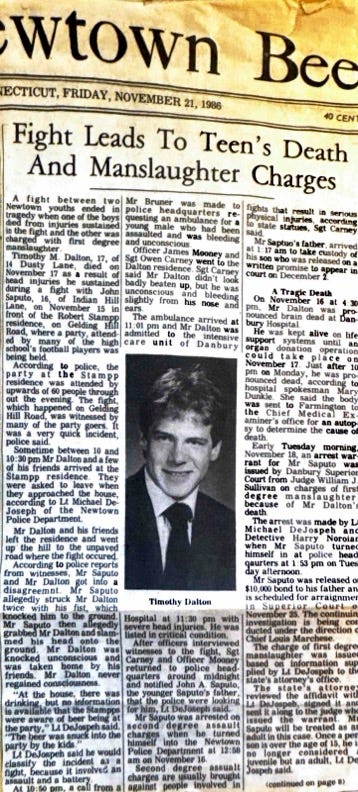
Later in the day, during my usual rounds, I picked up the crime report about the death at police headquarters, a converted farm equipment building on Main Street in Newtown, Connecticut. Armed with more details about this untimely tragedy, I called the deceased teenager’s mother to request a photo to accompany the obituary/crime story.
“Hello, Mrs. Smjekal?”
“Yes?”
“How are you?” Damn, did I just say that? Only silence on the other end of the line. I hadn’t yet learned to say, “I’m sorry for your loss, my condolences,” or other empathetic words to build rapport with a grieving member of the community. At twenty-five, a year out of college, my reporting skills were growing, but my people skills needed work.
“I’m writing... your son’s... obit.” More silence.
“I need a photo of Timothy for the article.” I didn’t like asking grieving people for things. It made me nervous asking for a photo of her dead son. I’m sure she had better things to do than talk with me. But it was my job as the obit writer and police reporter.
“I only have one copy of his school photo,” she said in a weak voice. “I don’t want to lose it. It’s all I have left of him.”
“I promise you if you bring it here to the paper, we will photograph it and give it right back to you.”
After I persuaded her to share her son’s photo, she told me her husband, the dead boy’s stepfather, died four months earlier in a plane crash that also killed a local industrialist.
“Oh no! That’s horrible,” I said. No shit, Sherlock. My chest tightened. I wanted to ease her pain as she seemed so sad, but I also wanted to know more.
“Tell me about Timothy,” I said. And for the next half hour, the sadness poured out of this newly grieving mother and still grieving widow. She perked up when she told me how proud she was of Timothy and how he was going, or should have gone, off to college next year. Later that afternoon, someone came to the newsroom with a small wallet-sized picture of Timothy.
A forbidden party
The Newtown High School football team had a good day on Saturday, November 15, 1986, its record now 7-2. One family threw a party at their Sandy Hook home that night. Most of the football team attended, including some uninvited teenagers. Around 10 p.m., a group of boys gathered at the top of the driveway, and a boy who lived there came out and asked the uninvited guests to leave.
An argument broke out between two of them, and Timothy Dalton, an uninvited guest, stepped between them to break it up. That was when John Saputo, a football player, punched him twice in the face with his fist. Timothy fell to the ground. John then picked up Timothy’s head and slammed it into the dirt road. Timothy never regained consciousness.
Timothy was brought to the hospital by friends an hour and a half later, bleeding from his mouth and ears. Doctors declared him brain-dead the next day. The hospital kept him on life support for an organ transplant. He was officially pronounced dead on Monday night at ten o’clock.
A first for a cub reporter
This was my first story about a killing, and I needed to get more information besides what I had learned from the funeral home and the police report before my Thursday deadline. I went to talk to a Newtown detective.
“Come in,” Michael DeJoseph, a 20-year veteran of the force, said, not looking up from his desk covered with stacks of typed police reports while a stuffed parrot hung from the ceiling, beckoning me to enter. We spoke for a few minutes about the football player’s arrest.
“You know how kids are, there wasn’t any drinking at the house,” he said as he leaned toward me as if he were telling me a secret in a whisper. I sat on the cold metal chair, writing quotes in my reporter’s notebook. My game with myself was working. I really felt like Lois Lane.
“But the parents weren’t aware that there was beer at the party. The beer was snuck into the party by the kids.” Now this was a quote I could use, and it wasn’t yet in the daily News-Times.
When I returned to The Bee, I called the state’s attorney to find out whether John Saputo, then 16, would be tried as an adult. He would. I also asked, “What’s the difference between murder and manslaughter?” I may have been a college graduate, but ‘Lois Lane, cub reporter’ still had a lot to learn.
I also interviewed the school principal, the police sergeant at the scene, football coaches, and others. Apparently, there was a rule that the football team was not allowed to attend parties. My first criminal death story appeared on Nov. 21, 1986, on the front page, “Fight Leads to Teen’s Death and Manslaughter Charges.” It still haunts me to this day.